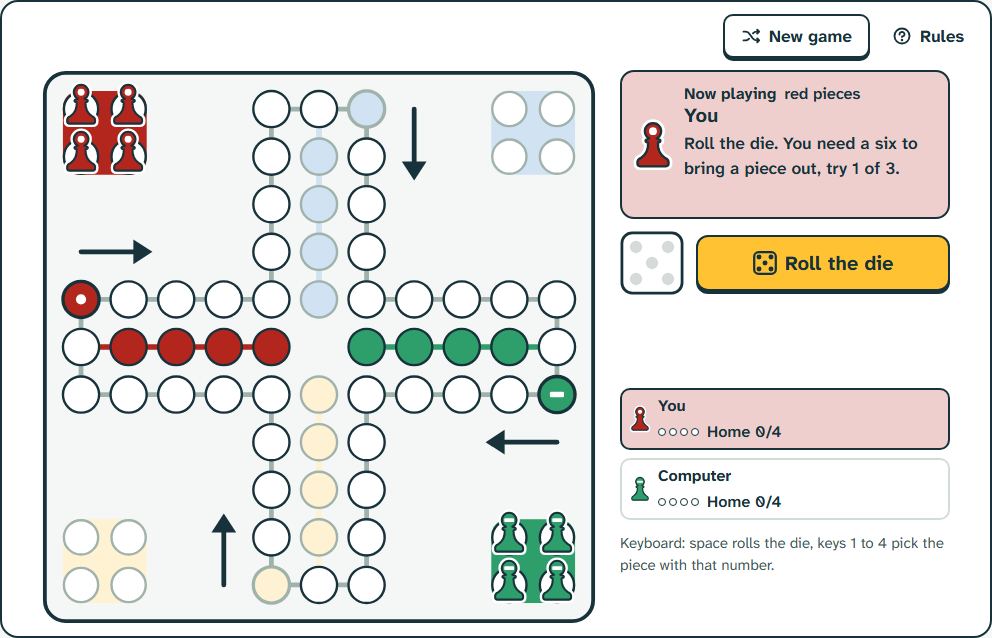
The Ludo on HoyHop is the version played in Central Europe. In Germany it is called Mensch ärgere Dich nicht, in Czechia Člověče, nezlob se and in Slovakia Človeče, nehnevaj sa. All three names mean roughly “Don’t get annoyed, mate”, which says a lot about what happens at the table. The board and the basic idea match British Ludo, but some rules differ, and every family has its own habits. The rules below are the ones Ludo on HoyHop uses, and the house rules you can switch on are at the end.
Board and pieces
The board is shaped like a cross. A track of 40 squares runs around its edge. Each of the four colours has a base with four pieces in its corner, one coloured start square on the track and four home squares in the middle of its arm.
Pieces move clockwise. Turns pass clockwise too. On HoyHop, red goes first. With two players the colours are red and green, with three players red, blue and green.
You can tell the colours apart without colour vision. A red piece has a dot on its head, blue a diamond, green a bar and yellow a triangle. The same mark is on each start square.
A turn
- Roll the die.
- Move one of your pieces that many squares. If more than one piece can move, you choose.
- If you rolled a six, roll again.
If no piece can move, the turn is lost and the die passes to the next player. The game says so and leaves a note below the die about what happened.
Bringing a piece out on a six
A piece leaves its base for the start square only on a six. At the start of a game everyone waits for their first six, and until it comes they have nothing to move.
When you roll a six and a piece is waiting in your base, you must bring it out. The exception is when one of your own pieces is already standing on your start square. Then you cannot bring a piece out and move another piece with the six instead.
Clearing the start square
As long as you have pieces in your base, the start square must be cleared as soon as possible. If one of your pieces stands on it, you must move that piece first, if the roll allows it.
Three tries
If you have no piece on the track, you get three tries to roll a six. This also applies when some of your pieces stand in the home row where they can no longer move. If no six comes on the third try, the next player takes over.
Capturing
If your piece ends its move on a square occupied by an opponent’s piece, the opponent’s piece goes back to its base. This also applies when you bring a piece out: if an opponent stands on your start square when you come out, you capture it.
You may not land on a square occupied by one of your own pieces. You may, however, jump over any pieces, yours or anyone else’s. Jumping captures nobody. Only the square where a piece ends its move counts.
The way home
After a full lap of the board, a piece turns into its own four home squares. Other colours may not enter them. You need an exact roll. A piece may not go past the last home square or land on one of your own pieces.
An example: your piece is one square of track away from its home row. A two takes it to the first home square, a five to the fourth and last one. A six would take it past the end, so you cannot move it with a six and must move another piece if you can. And if the fourth home square is already taken by one of your pieces, even a five will not do.
Inside the home row, pieces may still move forward and jump over each other. That is often useful when you need to make room for the next piece.
The end of the game
The game ends when the first player has all four pieces in the home row. That player wins. At home people often play on for second and third place. On HoyHop the game ends once there is a winner.
House rules
Three house rules can be switched on before the game. All are off by default.
- Capturing is compulsory. If you can capture a piece, you must. This does not apply when you have to bring a piece out or clear your start square. Many families play this way, but the German Wikipedia lists it only among optional rules for Mensch ärgere Dich nicht.
- Bringing out is optional. After a six you do not have to bring a piece out of your base, and you do not have to clear the start square right away. The game is calmer, but also longer.
- No jumping in the home row. A piece in the home row may not jump over another piece. Pieces have to be moved in the right order, so the last squares are harder to fill.
How it compares with British Ludo
People who grew up with British Ludo will find the basics familiar: a six to come out, an extra roll after a six, an exact roll to finish and capturing by landing on a piece. In the version on HoyHop there are no safe squares and no blocks made of two pieces. Every piece can be jumped over and captured anywhere on the track.
Playing with friends using a code
The Play with friends using a code button opens a room. Friends join with its code or QR code, and the computer can take empty seats. Who goes first is drawn at random. Only the player whose turn it is rolls and moves, the others see the roll and the move. If someone loses their connection, the game waits 45 seconds for them and then the computer plays for them until they are back. The details are in How to play online with friends using a room code.
Common questions
Can I jump over an opponent’s piece? Yes. Pieces are only captured on the square where a move ends.
Do I have to bring a piece out after a six? Under the rules on HoyHop, yes, if a piece is waiting in your base and your start square is not taken by one of your own pieces. Otherwise switch on the variant Bringing out is optional.
What if all my pieces are in the base? You get three tries to roll a six.
Ludo tips and strategy explains how to improve your chances. Where the game came from is told in The history of Ludo.