Almost everyone who has used a Windows computer knows Klondike solitaire. Once you sit down to play, though, it turns out that everyone remembers the rules a little differently. Can you take a card back from a foundation? What goes into an empty column? How many times can you go through the stock? The rules below are the ones Solitaire on HoyHop uses. Where people disagree, you will also find how the game is played elsewhere.
The goal
Klondike uses one standard pack of 52 cards without jokers. The aim is to move every card to the four foundations at the top right. Each foundation holds one suit (hearts, diamonds, spades or clubs) and is built upwards: ace, two, three and so on up to the king. When all four foundations hold a complete suit, you have won.
The deal
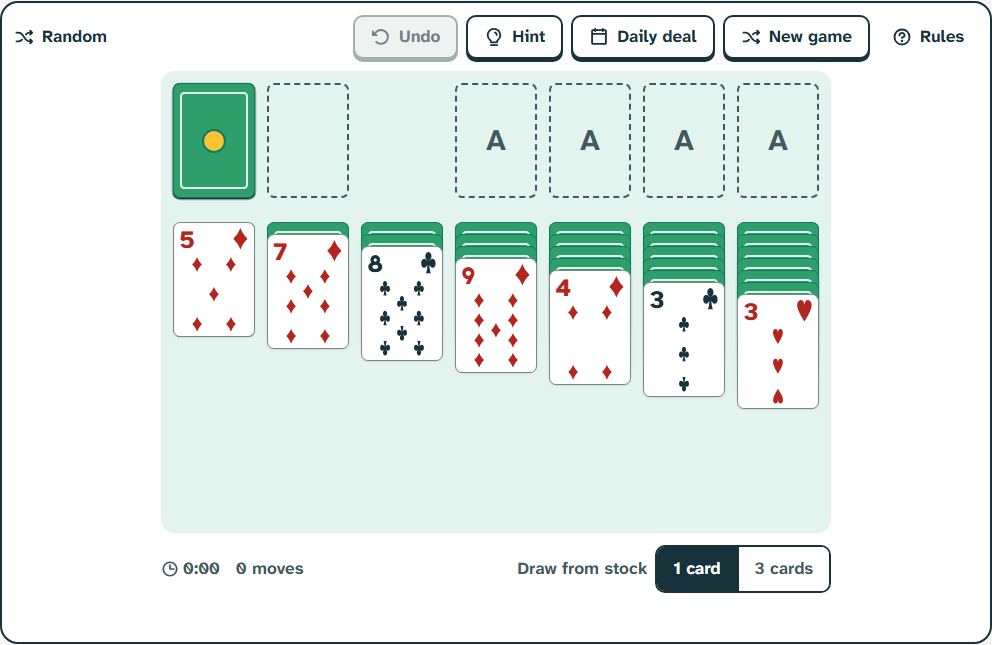
The cards are dealt into seven columns, also called the tableau. The first column from the left has one card, the second two, the seventh seven. That is 28 cards in total. Only the top card of each column is face up, the rest lie face down.
The remaining 24 cards form the stock at the top left. Next to it, a waste pile builds up during the game as you turn cards over from the stock. The foundations start empty.
Moves in the columns
The columns are your working area. Two conditions apply at the same time:
- The card you place must be one rank lower than the card you put it on.
- The colours must alternate: a red card goes on a black one and a black card on a red one.
So on a black ten you can put the nine of hearts or the nine of diamonds, but not the nine of spades or clubs. A black jack goes on a red queen. An ace never goes into a column. It goes straight to a foundation.
You can also move several cards at once. If a column has a face-up run, say a black eight, a red seven and a black six, you can move all three onto a red nine in another column. You can also take just the bottom part of the run, the seven and the six, if that helps somewhere else.
When the last face-up card leaves a column and a face-down card lies underneath, it turns over by itself.
Empty columns
When a column is completely empty, only a king may go there, either on its own or together with the run built on it. A queen, a ten or any other card cannot fill the gap. This rule is fixed in Klondike, and it is one of the differences from related games such as FreeCell, where any card may go into a free column.
Stock and waste
Tap the stock to turn a card onto the waste pile. Only the top card of the waste can be played, either onto a column or onto a foundation. When the stock runs out, tap it again to turn the whole waste pile back over and go through it again.
On HoyHop you can go through the stock as many times as you like. That is not the case everywhere. Book rules and many computer versions limit the number of passes. In the Las Vegas variant, which started as a casino gambling game, cards are dealt one at a time and the stock may be passed through only once.
Draw one or draw three
By default you draw one card at a time. This makes the game easier to follow and more deals can be solved. When you draw three, three cards turn over at once and only the one on top can be played. You reach the card underneath only after you have placed the top card somewhere.
The difference is bigger than it looks. With draw three, the order of the cards in the stock only shifts between passes if you play a card from the waste. If you play nothing, the next pass shows exactly the same groups of three. If you want to try both modes, note that changing the number of cards starts a new game on HoyHop. The daily deal is different for draw one and draw three.
Foundations and moving a card back
You can move a card to a foundation from the top of a column or from the waste, always in rising order and in the same suit. A double click or double tap sends a card to its foundation if it fits there.
You can move the top card of a foundation back into a column. Sometimes that pays off, for example when you need a red five to put a black four on, and the black four is covering hidden cards. Moving a card from one foundation to another is not possible, because each foundation belongs to a different suit.
The end of the game
A game ends in one of two ways. Either you move all cards to the foundations, or you find there are no useful moves left. Once all cards in the columns are face up, the win is certain and a Finish game button appears, which moves the rest of the cards to the foundations for you.
Not every deal can be won, and with a random deal there is no way to guarantee it. Calculations for so-called Thoughtful Klondike, a version in which the player can see every hidden card, put the upper limit at about 82 percent of deals with draw-three rules. A real player cannot see the hidden cards and so wins less often. The daily deal on HoyHop is picked so that a solution exists, and it is the same for every player on a given day.
Common questions
Can I put a queen into an empty column? No. Only a king, with or without cards on it, can go into an empty column.
Is there a score? Solitaire on HoyHop does not keep points like the old Windows version. It measures the time from your first move and the number of moves, including turning cards over from the stock.
Can I take back a move? Yes. The Undo button takes back the last move and works all the way back to the start of the game. On a keyboard, Ctrl+Z does the same.
What if I get stuck? The Hint button lifts a card worth moving and marks where it goes. When there is no useful move left, it tells you so. How to avoid getting stuck is the topic of Solitaire tips and strategy.
Where the name comes from
Nobody knows for sure where the name Klondike comes from. It is often linked to the Klondike Gold Rush at the end of the 19th century, but there is no direct evidence. The earliest known rules appeared in 1907 in the handbook Hoyle’s Games under the name Seven-Card Klondike. You can read more in The history of solitaire.