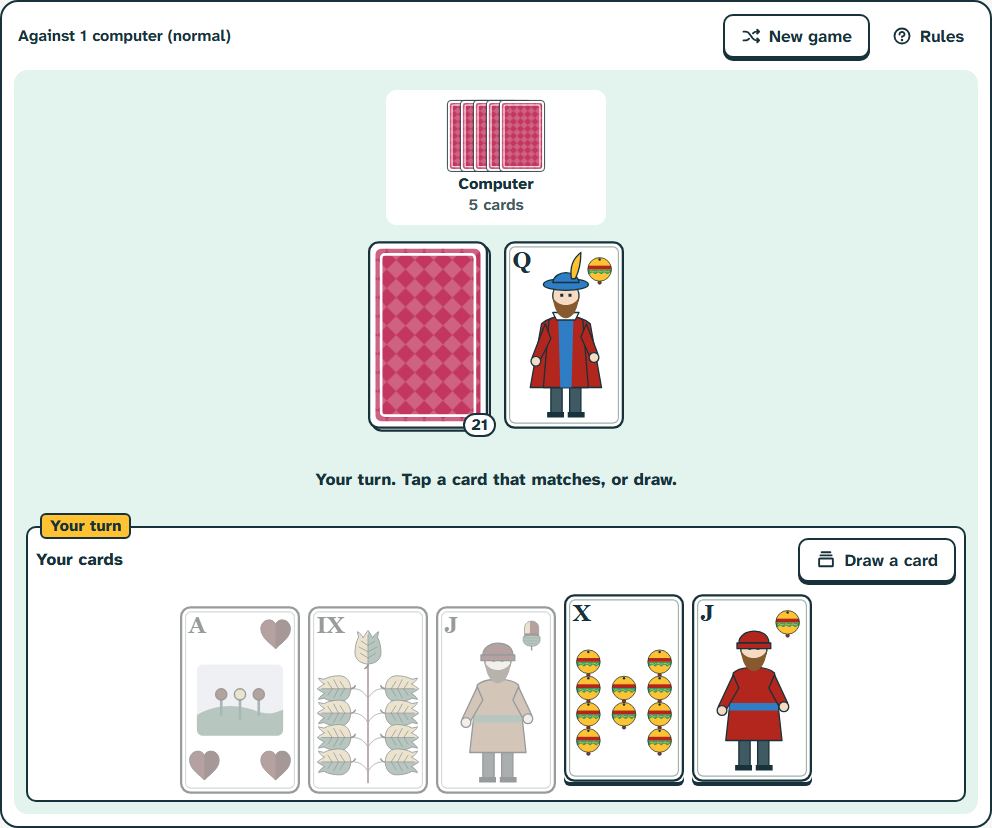
Crazy Eights is a shedding game: everyone tries to get rid of the cards in their hand before the others do. The version on HoyHop is the one played in Czechia and Slovakia, where it is called Prší and Faraón. It belongs to the same large family as Mau-Mau in Germany and Crazy Eights in English-speaking countries, but it is played with 32 German-suited cards and a few rules of its own. Rules vary from family to family, so this article describes exactly how Crazy Eights on HoyHop works and points out where other versions differ.
The cards
The game uses 32 single-headed German-suited cards, the kind Czechs and Slovaks know from the game Mariáš. There are four suits: Hearts, Leaves, Acorns and Bells. Each suit has eight ranks: VII, VIII, IX, X, Unter, Ober, King and Ace.
Players used to French-suited cards often find it hard to tell the Unter from the Ober. Both are figures, but the Unter shows its suit sign low on the card and the Ober high. That is why every card on HoyHop also has a letter in the corner: J for the Unter, Q for the Ober, K for the King and A for the Ace. The ranks VII to X appear in the corner as Roman numerals.
The deal
Each player gets five cards, as is usual in Slovakia. In Czechia four cards are more common, so you can choose that before the game. One card is turned face up to start the discard pile. The rest of the cards form the stock.
The first face-up card counts as an ordinary card, even if it is a seven or an ace. Nobody draws for it and nobody misses a turn. If the first card is an Ober, it keeps its own suit.
A turn
The player whose turn it is has two options:
- Play one card of the same suit or the same rank as the top card of the discard pile. On the IX of Leaves you can play any Leaves card or any nine.
- Draw one card from the stock. That ends the turn, even if the card you drew could be played straight away.
You may draw even when you could play. Sometimes that is the sensible choice, for example when you want to keep an Ober for later.
When the stock runs out, all cards of the discard pile except the top one are shuffled into a new stock. If there is nothing left to draw, you must play, and if you cannot, the turn simply passes on.
Sevens
After a seven, the next player draws two cards and their turn ends. They can defend themselves, though: if they have a seven too, they play it and the penalty moves on. The next player then draws four cards, after a third seven six cards, after a fourth eight.
While a seven is active, meaning nobody has drawn for it yet, nothing but another seven can be played on it. Not even an Ober.
Aces
An ace means the next player misses a turn. Again you can defend with an ace of your own, and the player after you misses the turn instead. While an ace is in force, no card other than an ace can be played on it, and you cannot draw from the stock either.
The Ober
The Ober is the card that changes the suit. It does the job that the eight does in English Crazy Eights. You can play it on any card, whatever its suit or rank. The exceptions are an active seven and an active ace, which have to be dealt with first. Whoever plays the Ober calls one of the four suits, and the next player has to follow that suit or play another Ober.
On HoyHop an Ober can also be played on another Ober, and the suit you call does not have to be the Ober’s own suit. That can be useful: if an opponent has one card left and you suspect it is a Leaves card, call a different suit.
The end of the game
The first player to get rid of all their cards wins. The last card can be any card, including a seven or an Ober. When you play against several computers, the game ends with the winner. Nobody plays on for second place.
Variants on HoyHop
Two house rules can be switched on before the game. Both are off by default.
- A seven makes you draw three. Stacking works the same way, but the penalties add up in threes: three, six, nine, twelve.
- The Seven of Hearts brings a player back. When someone plays their last card, the next player can bring them back with the Seven of Hearts, if it can be played. The returning player draws as many cards as for an ordinary seven, and the game goes on. If their last card was also a seven, they draw the total.
How it is played elsewhere
The Czech Wikipedia lists several more customs for Prší. In some places any seven brings a finished player back. Elsewhere the King of Leaves makes the next player draw four. In pub versions the Unter changes the suit as well, and a ten reverses the direction of play. Rules like these always need to be agreed before the first game.
German Mau-Mau differs more. An eight makes the next player miss a turn instead of an ace, the Unter changes the suit, and a player down to their last card has to call out “Mau”. Forgetting means drawing a penalty card. HoyHop does not use calling, so you just keep an eye on how many cards your opponents have left.
In English Crazy Eights the game uses a full pack of 52 cards and the eight changes the suit, which gives the game its name. According to pagat.com, each player gets five cards, or seven each when there are only two players.
Common questions
Can I draw even if I have a card to play? Yes. Your turn ends.
Can I play straight after drawing? No, drawing ends your turn.
Does a seven count if it is the first card turned up? No, the first face-up card is an ordinary card.
Can I answer an ace with a seven? No. An ace can only be answered with an ace and a seven only with a seven.
How many can play? Against the computer, two to four players, meaning you and one to three opponents. Before the game you also choose whether the computer plays Easy or Normal. With friends using a room code, also two to four, and the computer can take empty seats. How to play online with friends using a room code explains how.
If you want to play better, have a look at Crazy Eights tips and strategy. Where the game came from is the subject of The history of Crazy Eights, Prší and Faraón.