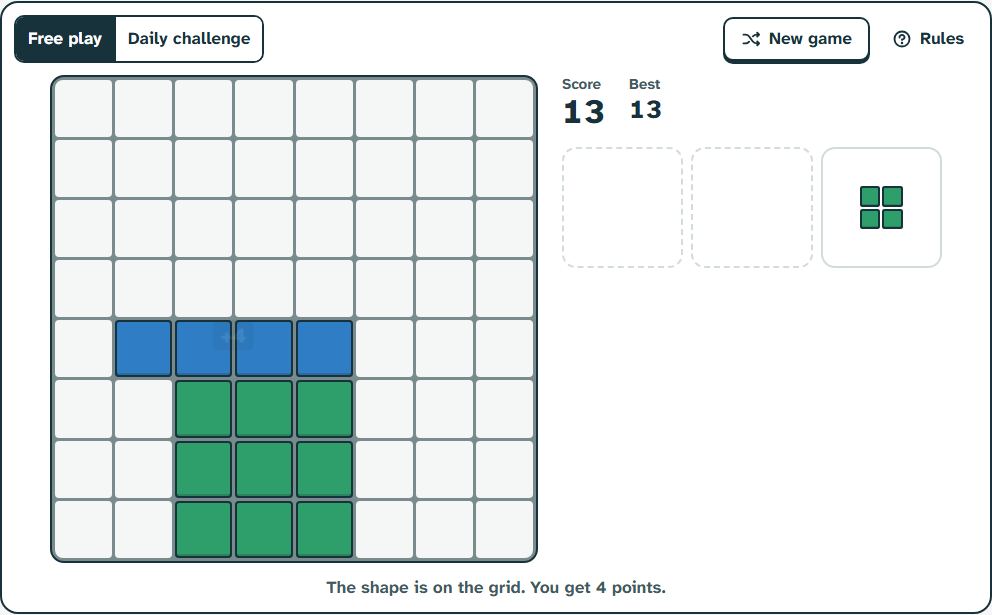
Block Fit is a puzzle without a time limit. You place shapes made of squares on a square grid and try to fill whole rows and columns, which then disappear. You can learn the rules in seconds, but there are a few details about scoring and the daily challenge that are worth knowing.
The grid and the shapes
The board is 8 by 8, which makes 64 cells. It starts empty. Below the grid, or next to it on a wide screen, there are always three shapes. You can place each of them on empty cells of the grid.
Shapes cannot be rotated. If the game offers a horizontal line, you have to place it horizontally. That is why every rotation of a shape is a separate shape in the set. The set contains:
- a dot of one cell,
- lines of two, three, four and five cells, horizontal and vertical,
- squares of 2 by 2 and 3 by 3,
- rectangles of 2 by 3 and 3 by 2,
- a small corner of three cells in four orientations,
- a large corner of five cells inside a 3 by 3 square, also in four orientations,
- L and J shapes of four cells,
- T, S and Z shapes.
L, J and T come in four orientations, S and Z in two. Large shapes with five or more cells, meaning the five-cell line, the large corner, the rectangles and the 3 by 3 square, appear at most once in any set of three.
Placing shapes
- Pick one of the three shapes.
- Place it on empty cells. No cell of the shape may lie on an occupied cell or outside the grid.
- You can place the three shapes in any order.
- Once all three are placed, you get three new ones.
The game shows you what will happen as you aim. A preview with a dark outline shows where the shape will land. A light frame on cells means that line will disappear once you place the shape. Cells with a red cross and a dashed outline mean the shape does not fit there. A shape that fits nowhere on the grid turns grey in the offer.
When a line clears
When a whole row is filled, all eight cells side by side, it disappears. A full column disappears in the same way. If one shape fills a row and a column at the same time, both disappear, even though they share a cell. If it fills two rows and a column, all three go.
The cells that remain do not move after a line clears. There is no gravity as in Tetris. The blocks stay exactly where they were, with an empty line between them.
Points
Your score has two parts:
- For placing a shape: one point for every cell of the shape. A dot is worth 1 point, a 3 by 3 square 9 points.
- For cleared lines: depending on how many lines disappear in one move.
| Lines at once | Points |
|---|---|
| 1 | 10 |
| 2 | 30 |
| 3 | 60 |
| 4 | 100 |
| 5 | 150 |
| 6 | 210 |
Rows and columns are added together. For n lines at once you get 10 × n × (n + 1) / 2 points. Each extra line is therefore worth more: the second line adds 20 points, the third 30, the fourth 40.
An example: you place a 2 by 2 square and fill two rows with it. You get 4 points for the cells and 30 for the two lines, 34 in total. If you had filled the same two rows one after the other in two moves, the lines would have earned you only 10 and 10, so 10 points less.
You cannot clear more than six lines at once. The most are reached by the 3 by 3 square or the large corner, which cover three rows and three columns, and by the five-cell line, which covers five rows and one column.
The end of the game
The game ends as soon as none of the shapes on offer fits on the grid. That does not have to be all three. If you have already placed two and the third fits nowhere, the game is over. The game remembers your best score in this browser.
Free play
In free play the shapes are random, and you play as long as one of them fits. The game tries to be fair about it. Before it offers a set of three, it tries a few random sets and picks one that can be placed in full on the current grid. That cannot always be guaranteed. On a very full grid, sometimes no such set exists.
The daily challenge
The daily challenge has 30 shapes, ten sets of three, in the same order for every player. The challenge ends when you have placed all 30 shapes or when none of the shapes on offer fits. You can try it as often as you like, and your best score of the day counts. A new challenge starts at midnight.
Because the shapes are the same for everyone, daily scores can be compared. That makes it a good family competition: whoever scores most with the same thirty shapes wins.
Controls
- Mouse: click a shape, then a spot on the grid. The preview shows where the shape will land. You can also drag the shape.
- Touch: tap a shape, then a spot on the grid. If it does not fit there completely, the game shows the nearest free spot, and another tap places the shape. When you drag with a finger, the shape stays above your finger so it is not hidden.
- Keyboard: press 1, 2 or 3 to pick a shape, move it with the arrow keys and place it with Enter. Esc cancels.
A game in progress is saved and continues after a page reload.
Related games
Games in which shapes are placed on a square grid and full lines disappear spread on mobile phones in the middle of the last decade. One well-known example is 1010! by Gram Games from 2014, with a 10 by 10 grid. They differ from Tetris in that nothing falls and nothing hurries you. All that matters is where you put each shape.
Block Fit tips and strategy explains how to get higher scores.