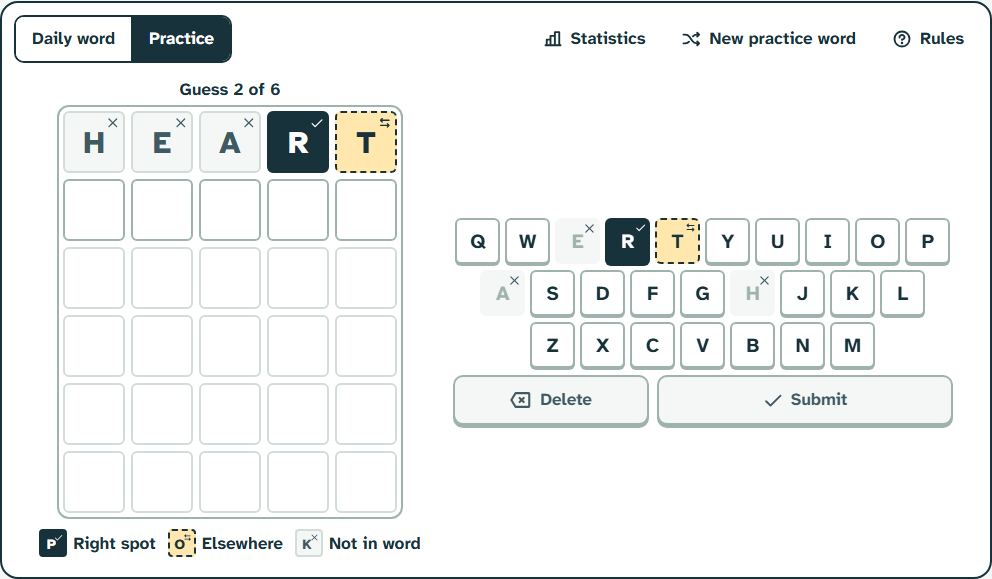
Daily Word is a puzzle in which you have a few guesses to find a hidden word. If you have played Wordle, you will feel at home straight away. There are a few differences, though: the word length changes from day to day, the tiles use marks as well as colours, and both American and British spellings are accepted. Here are the rules down to the last detail.
One word for everyone
The daily word is the same for every player in a given language. It changes at midnight Central European Time. Whether you play in the morning or in the evening, you are guessing the same word as everyone else, so you can compare results with family or colleagues. When the game ends, the Share button copies a short text with the number of the word and the number of guesses, without giving the word away.
Some days the word has five letters, other days six or seven. The game shows the length above the board, and you can see it in the number of tiles in each row. You always get one guess more than the word has letters: six for five letters, seven for six and eight for seven.
Making a guess
Type your guess on the on-screen keyboard or on your computer keyboard. When every tile in the row is filled, press Submit or Enter.
A guess must be a word the dictionary knows. It can be in any form. If you are looking for a five-letter word, you can try apple, but also forms such as walks or eaten, as long as they have the right length. A word the dictionary does not know does not count as a guess and costs you nothing. The same goes for a word you have already tried in this game.
What the tiles mean
After you submit, each tile of your guess is marked to show how the letter fits:
- Solid dark tile with a check mark: the letter is in the word and in the right spot.
- Light yellow tile with a dashed outline and arrows: the letter is in the word, but in another spot.
- Faded tile with a cross in the corner: the letter is not in the word.
Each state has its own mark as well as its own colour. You can play even if you find some colours hard to tell apart, or on a dim screen.
The keys of the on-screen keyboard are marked in the same way. A key whose letter is not in the word fades and is crossed out, so you can see at a glance which letters are still left.
Double letters
Letters that appear twice in a guess cause the most questions. The rule is this: a letter is marked as found at most as many times as it appears in the hidden word. A letter in the right spot is marked first.
An example: the hidden word is horse and you guess robot.
- R in first place: horse has an r, but in third place. Yellow.
- O in second place: horse has an o in exactly that spot. Dark.
- B: not in the word. Faded.
- O in fourth place: horse has only one o, and it is already marked in second place. Faded.
- T: not in the word. Faded.
So the second o does not mean the word has another o. If the hidden word had two, both would be marked.
American and British spelling
The hidden word is always spelled the same way in American and British English. You will not get a word like colour or color as the answer.
Your guesses are checked against spell-checking dictionaries for both, so both spellings count as guesses. You can type colour or color, centre or center, whichever you are used to.
Which words are answers
The hidden word is always a common noun in its basic form, for example apple or garden. There are no verbs, adjectives, names or rare technical terms among the answers.
Guesses are checked in a spell-checking dictionary that also contains other forms of words. Rude and offensive words have been removed, so you cannot use them even as guesses. The sources of the dictionaries and their licences are on the Licences page.
Winning and losing
The game ends when you guess the word or run out of guesses. Either way you see the hidden word. Once the daily word is over, the game shows how long it is until the next one. If you want to keep playing, you can switch to a practice word.
Practice words
In Practice mode you get a random word with five to seven letters. You can play as many as you like, and they do not count in the statistics. It is a good way to try out a strategy without spoiling your result for the day.
Statistics and streak
The statistics show how many daily words you have played and solved, and on which guess. The streak, the number of days in a row with a solved word, is off by default. You can switch it on in the statistics with Count streak. If you do not want to feel you have to play every day, just leave it off.
Your current game and your statistics are saved in this browser.
Slovak and Czech versions
Daily Word also has Slovak and Czech versions. Each has its own dictionary and its own daily word, so they are not translations of the same word. In those languages, letters with accents count as separate letters, so a and á are two different letters, and the pair ch is typed as two letters.
Daily Word tips: first words and next guesses explains how to guess faster. The games that Daily Word grew out of are the subject of From Jotto to Wordle.